

Pulse Power Calibration
It may be desirable for a variety of experiments to calibrate the pulse power from the flash stimulus. Here we provide an example of how to calibrate the approximate optical power delivered to the animals during a stimulus event delivered by the fluorescence LEDs.
Note that absolute measured intensity will vary based on the distance between the animals and the light source, as well as the exact wavelength used for illumination.
The average power will also be a function of the pulse duration. The LEDs can take up to 200 ms to reach their peak power, and as they heat up the power will decrease.
As of Version 0.19.135, 1% fluorescence brightness is equivalent 1,000 lux as displayed on the interface.
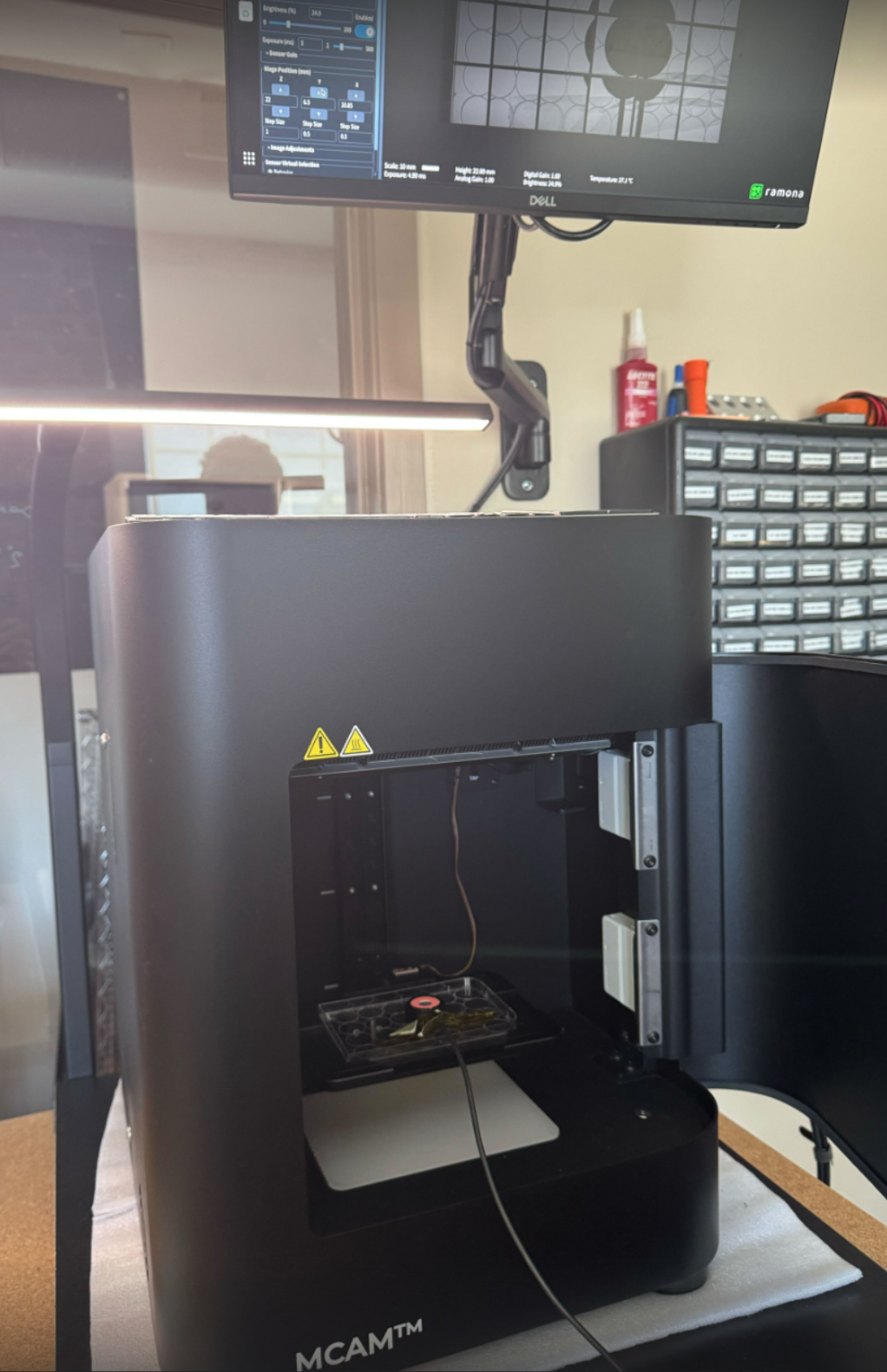
In the following setup, we used a Thorlabs PM100A power meter with a S120C sensor to measure the power at the z-stage location where a wellplate would be in behavior experiments. The sample setup is shown in the image below.
We then increased the intensity of the light source in 10% increments and recorded the measured peak power for 1s pulses.
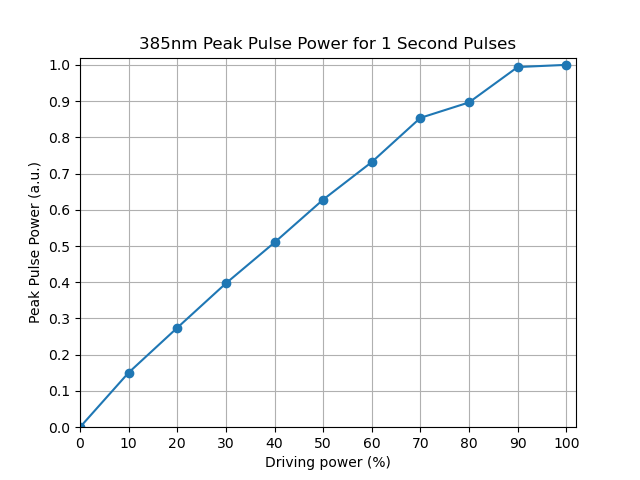
As one can see, the power increases linearly with the intensity saturating roughly at 90%.
Note that while the S120C’s responsivity is not specifically calibrated for 385 nm, the weak response of the photodiode can still be used to estimate the linearity of the flash stimulus.